
Plan Your High-School Courses & Academics

The courses you choose in high school shape what you learn and which classes you can take later. A little planning helps you make room for subjects you enjoy, prepare for college or training, and avoid discovering a missing requirement in senior year.

A student studies with a notebook and laptop in a library.

Start with your interests and current courses

A student writes in a notebook at a classroom desk.

Think about the classes you enjoy and subjects you would like to explore. An interest in health might lead you toward biology; an interest in design might lead you toward art, engineering or computer courses. You can explore more than one direction before choosing a career.

Your current work also helps you decide what comes next. Which subjects do you understand well? Where are you still building basic skills? Look at recent assignments and grades alongside your interests. A class you enjoy may be a good place to try more advanced work, while another subject may need more practice first.

Have your school’s course catalog and a list of completed and current courses beside you. The catalog explains available classes, so you can start with options your school actually offers.


Understand requirements and course sequences

A student reviews written guidance with an adviser.

Graduation requirements are the courses and credits you need for your high-school diploma. Common subject areas include English, math, science and social studies, along with requirements such as physical education, health and electives. Your school’s graduation checklist gives the exact subjects and amounts needed.

College preparation can go beyond that checklist. Colleges may expect additional math, laboratory science or study of a world language. A required course is a condition you must meet; a recommended course indicates preparation the college values. College Board’s overview of high-school courses explains the main subject areas.

If you do not have colleges in mind yet, keep a broad mix of academic subjects in your plan. As your interests become clearer, compare the published course expectations of colleges or training programs you are considering.

A prerequisite is a course or other requirement you must complete before taking another course. For a class that interests you, find out what comes before it and when you can take it. Your school’s course catalog may also list a placement requirement or teacher approval.

For example, imagine Mai is choosing Grade 10 courses and hopes to take advanced biology in Grade 11. Her school requires introductory biology and chemistry first. Mai has completed biology but planned to leave chemistry until later. Seeing the sequence shows her two possible plans. She could take chemistry in Grade 10, or move advanced biology to Grade 12. Checking early gives her time to choose.

Choose a suitable level of challenge

Advanced classes let you study a subject in greater depth or at a faster pace. The labels describe different options.

  • Honors classes generally go deeper or move faster than standard classes. They are high-school courses; the label itself does not award college credit.
  • Advanced Placement (AP) offers college-level courses and subject exams for high-school students. A qualifying exam score may earn credit toward a college degree or placement into a more advanced class, depending on the college. AP exam planning has its own deadlines.
  • International Baccalaureate (IB) offers advanced courses. Its full diploma program combines several subjects over two years, so choosing that program involves planning a connected schedule.
  • Dual enrollment means taking college courses while still in high school. A course may also meet a high-school requirement. The grade becomes part of a college academic record, and future colleges decide how they will use the credit.
A student raises a hand in a classroom.

For dual enrollment, the immediate questions are whether the course fits your graduation plan, what it costs and whether its schedule works for you. Your school’s program information should explain these basics. You can investigate transfer credit later when you have possible colleges in mind; do not assume every course will shorten a future degree.

For students in Wisconsin, local starting points include the Universities of Wisconsin dual-enrollment information and Wisconsin Technical College System dual-credit information.

To judge whether you are ready for a more advanced class, consider whether you understand the current material, usually complete the work and can manage a faster pace or more independent assignments. Read the next course’s description. If you are unsure, a teacher who knows your work can help you choose between levels.

Look at the whole schedule, too. Homework from several demanding courses can add up to an unmanageable workload. You might choose an advanced class in a subject you enjoy while staying at the standard level elsewhere. Leave enough time for your other classes, work, responsibilities at home and sleep. There is no single number of AP classes that suits every student.

If your school offers few advanced options, choose the most challenging courses that fit your preparation and workload from those available. Colleges may consider how much you challenged yourself within your school’s offerings; Yale’s course-selection guidance explains one college’s approach.

Build, review and use your course plan

A sheet of paper or a simple document with columns for Grades 9–12 is enough.

  • Enter completed and current courses.
  • Add the remaining graduation requirements.
  • Place prerequisites before the later courses they support.
  • Add suitable courses that develop your interests and prepare you for possible next steps.
  • Mark alternatives where you have not decided yet.
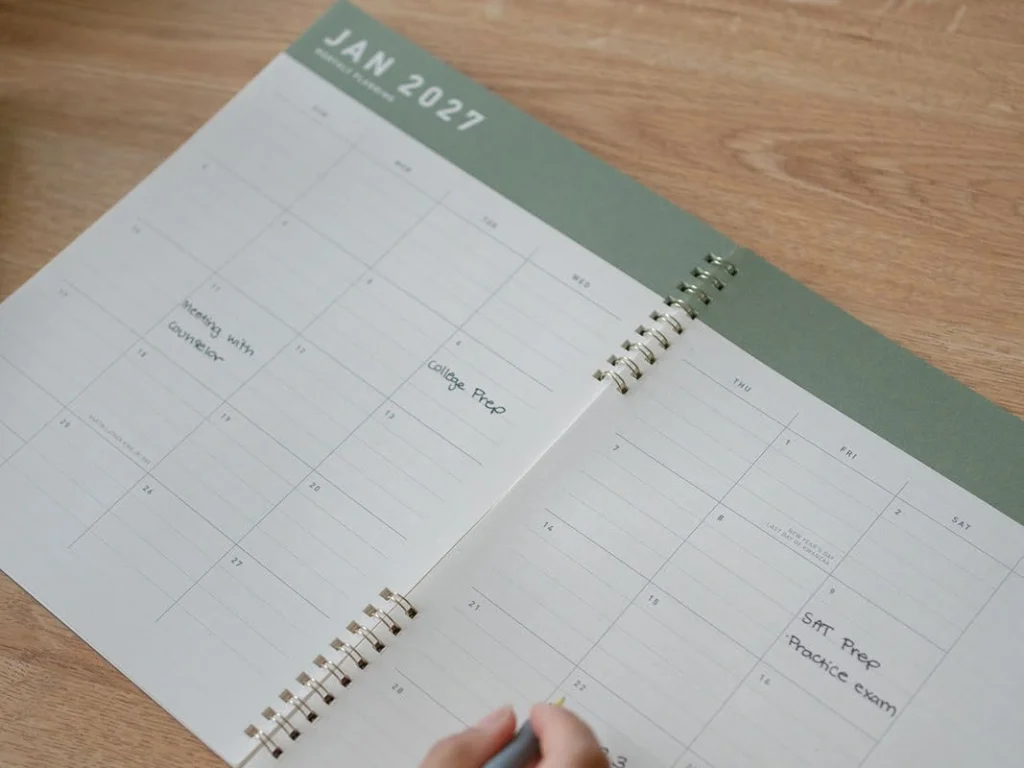
A student writes in a planner beside course materials.

Before course selection period ends, review the draft with your counselor. This is the time to catch a missing requirement, confirm an unclear sequence or resolve a scheduling conflict. Then submit your choices through your school’s selection process.

Once classes begin, a few habits help the plan work. Keep assignments and deadlines in one place, begin larger projects before the final evening and review mistakes after tests. If a class becomes difficult, bring a problem you got stuck on to your teacher, or use school tutoring or study sessions where available.

Review your plan before each year’s course selection and when a course change affects what you can take next. In Grade 11, check that Grade 12 includes your remaining graduation requirements and preparation for the paths you are considering. If workload is regularly costing you sleep or leaving several classes unfinished, discuss an adjustment before changing or dropping a course.